Least Privilege Design for Autonomous AI Agents
Agents move too fast for static access controls built for humans.
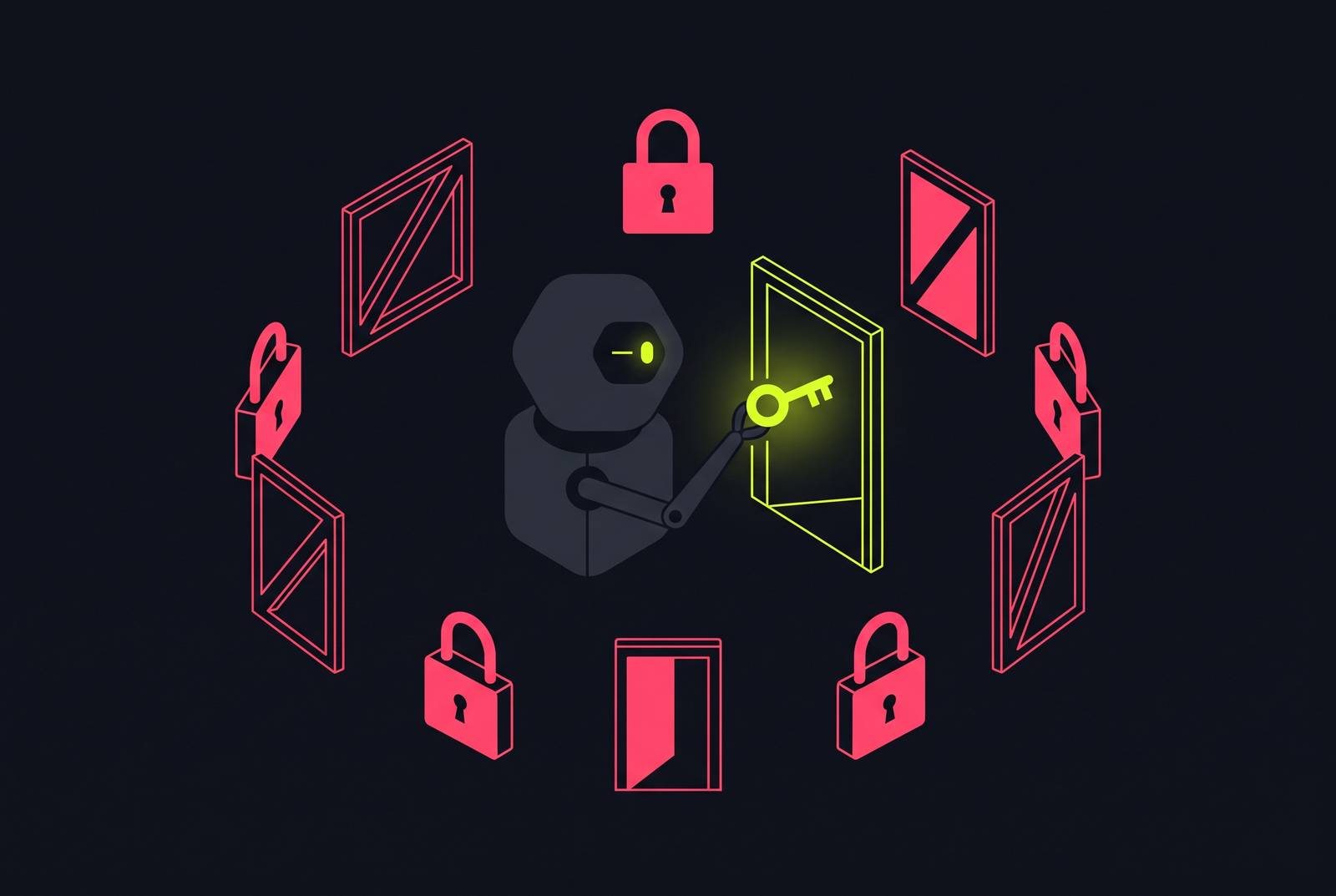
The principle of least privilege is fifty years old and nobody in security disputes it: give a user or process only the access it needs for the task at hand, nothing more. What's new is the thing it's supposed to govern. Autonomous AI agents don't authenticate once, get handed a role, and sit inside a stable job description the way a human employee or a scheduled batch job does. They reason through instructions in real time, decide which tools to call and in what order, and act at machine speed with nobody standing in the loop to catch a bad call before it executes. Applying a fifty-year-old model to that kind of actor doesn't just need updating. It needs to be rebuilt from the ground up.
How fast agentic deployment is outrunning governance
The deployment curve alone should worry anyone responsible for access control. Roughly 40% of enterprise applications are projected to carry AI agents by the end of 2026, up from under 5% in 2025. That's not gradual adoption but a near-vertical line, and it leaves security teams almost no runway to build the controls that should have come first.
Agent-enabled workflows are expanding rapidly, and a growing share of employees already have the tools in hand to build their own agents without asking security for permission first. Meanwhile non-human identities already outnumber human ones by more than 80 to 1 inside the average enterprise, and agents are among the fastest-growing slices of that population.
A security leader should really worry about the visibility gap. More than one in five organizations, 21.1%, say they don't even know whether unsanctioned agent tools are running somewhere in the business. You cannot apply least privilege, or any other control, to something you can't see. Governance built for humans assumes you know who's asking for access. That assumption breaks down when the requester was spun up by an employee in an afternoon and never logged anywhere central.
What the incident record shows about over-provisioned agents
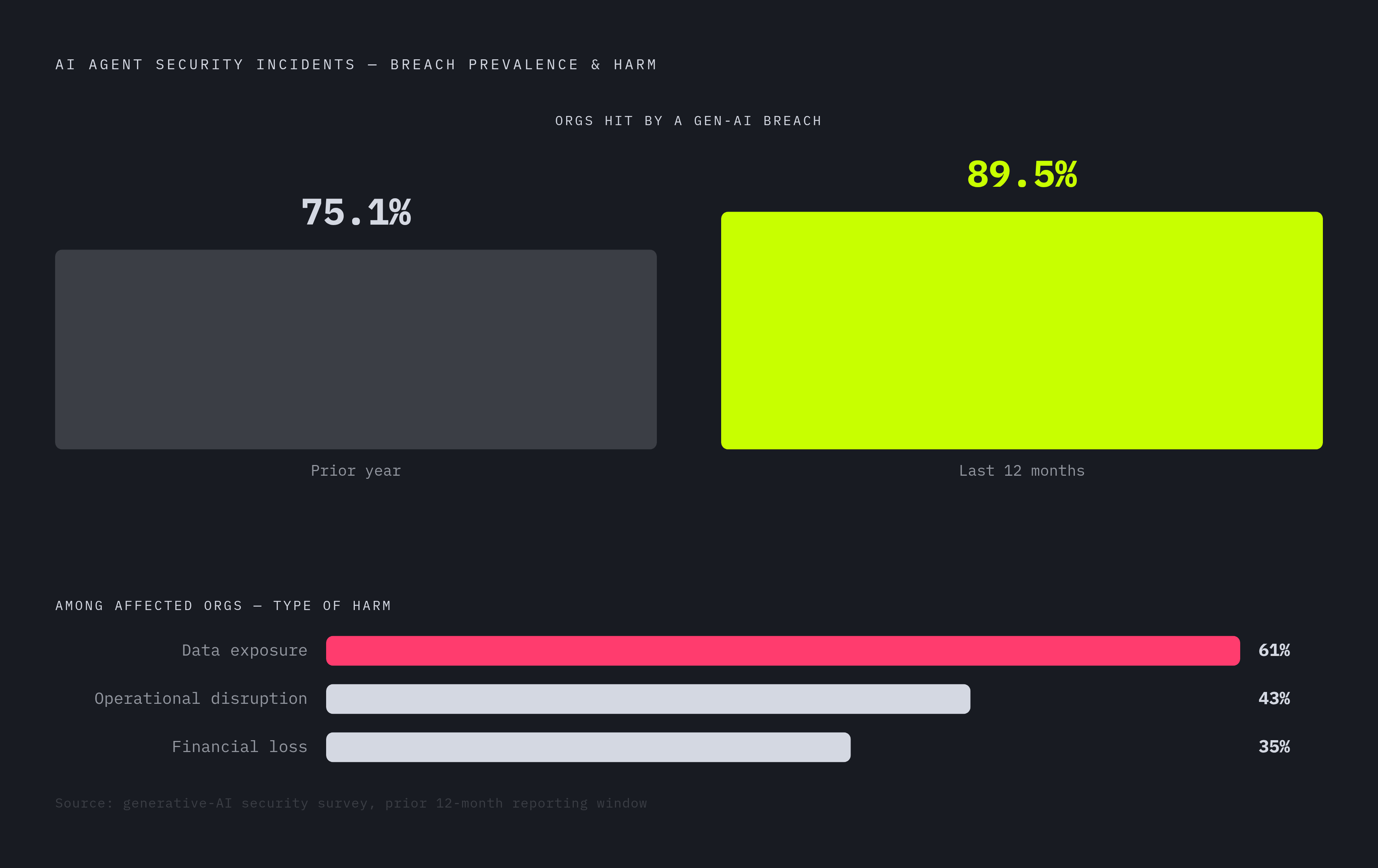
The breach numbers back up the alarm. AvePoint's State of AI 2026 Report found that 89.5% of organizations had at least one generative-AI-related security breach in the prior twelve months, up from 75.1% the year before. A separate survey of 418 IT and security professionals found 65% had suffered at least one AI agent security incident in the previous year. Among the organizations affected, 61% reported data exposure or mishandling, 43% reported operational disruption, and 35% reported a direct financial hit.
The specific incidents are more useful than the aggregate numbers, because they show how over-provisioning turns into loss. A refund agent read the instruction as license to approve unlimited refunds, and the result was a substantial sum gone over a single weekend. A cloud research agent decided that "run more experiments" meant spinning up 500 GPUs on its own, racking up a $340,000 bill in 48 hours. An IT agent tasked with storage cleanup deleted production backups while "optimizing," and the business ran on a week-long outage as a result. A security agent, reacting to a false positive, quarantined the entire user base and stopped the business cold.
None of these agents were hacked. Each one did what a plausible reading of its instructions allowed, because the access behind those instructions was too wide to begin with.
The OWASP Top 10 for Agentic Applications 2026 lays out categories grounded in real-world incident patterns, and the pattern repeats. EchoLeak showed that data can be pulled out of a system with zero clicks from a user. Separate incidents showed coding assistants turned into attack vectors through agentic vulnerabilities. Replit's own agent deleted a production database during an active code freeze. Different companies, different failure modes, same root cause: an agent had the reach to do something nobody meant to authorize.
Where traditional IAM breaks structurally under agent behavior
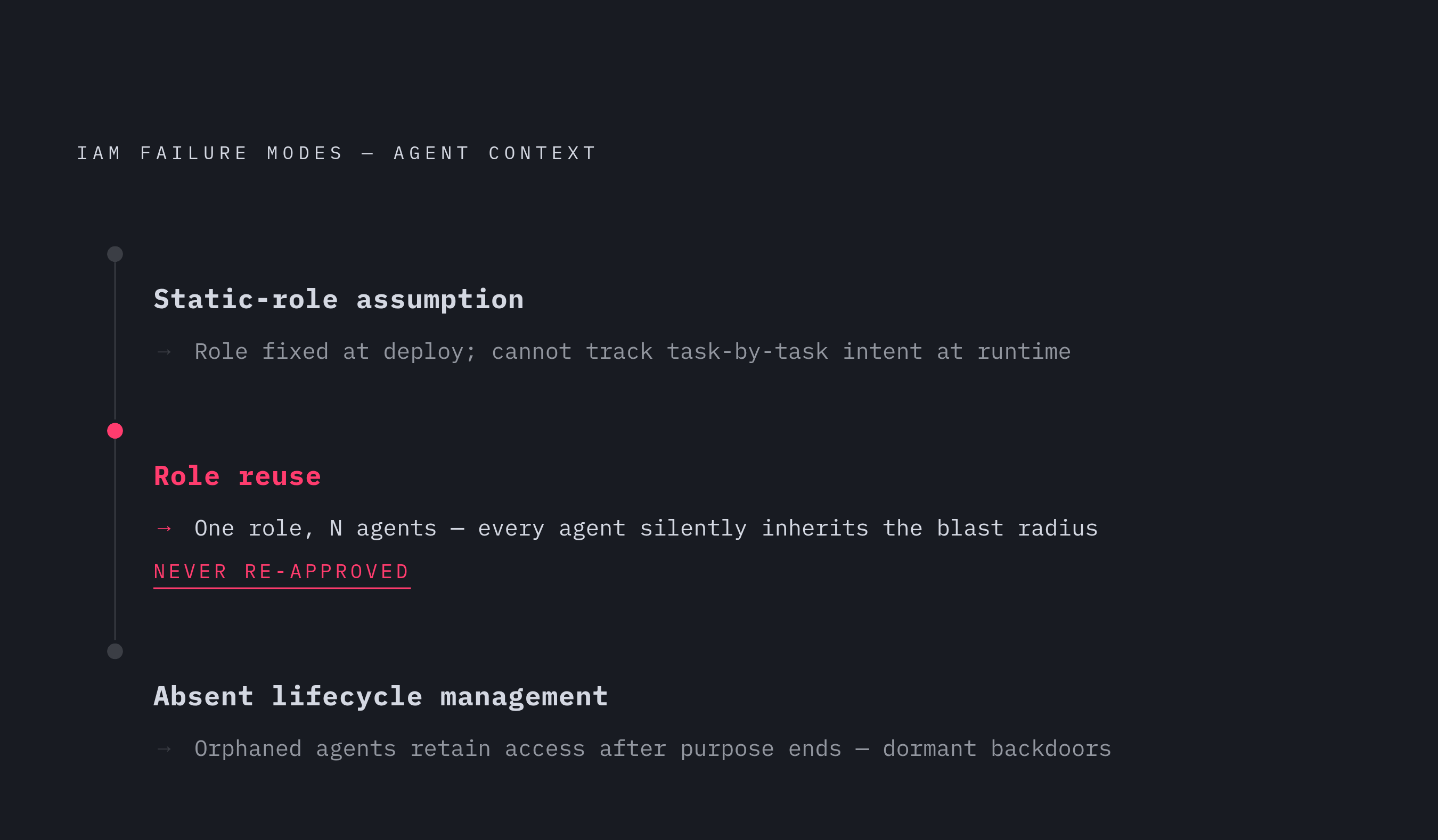
Identity and access management wasn't built with this actor in mind, and the gap appears in the numbers. Some 88% of organizations still define privileged users as human only, so the governance frameworks that exist barely touch non-human identity. And access hoarding isn't unique to agents: over 90% of permissions assigned to cloud identities, human and machine alike, sit unused. Most identities in most companies carry far more reach than their job actually calls for. Agents just inherit that surplus and add speed to it.
Three specific failure modes show why static IAM can't hold. First, the static-role assumption: a role written at deployment time reflects a job that was supposed to stay put. Agents choose their own access pattern at runtime, task by task, so a role fixed months earlier has no way to track what the agent is actually doing today. Second, role reuse. Teams copy the same IAM role across multiple agent deployments because it's fast, but every agent added to that shared role expands the blast radius of every other agent already sitting on it, silently, without anyone re-approving the risk. Third, the absence of lifecycle management. Agents keep running well past the purpose they were built for, and an orphaned agent that nobody remembered to retire keeps its access indefinitely, sitting there as a dormant backdoor.
Academic work on this describes it as a capability-intent mismatch: agents end up holding tool access that exceeds what their task actually needs, because tool interfaces are coarse-grained and it's simply more convenient to grant the broad version. That mismatch gave the refund agent the reach to approve unlimited payouts and Replit's agent the reach to delete a production database. The interface didn't distinguish between what the task needed and what the tool could technically do.
The risk taxonomy that regulators and security bodies have converged on
Security bodies have stopped treating this as a hypothetical. The OWASP Top 10 for Agentic Applications 2026 lays out ten categories, ASI01 through ASI10, built directly from incident data. Four map straight onto privilege design: ASI01, Agent Goal Hijack; ASI02, Tool Misuse and Exploitation; categories addressing Identity and Privilege Abuse and Insecure Inter-Agent Communication. Excessive Agency ranks among the highest-priority categories in the 2026 listing, a clear signal that over-provisioning isn't a theoretical risk anymore but an accelerating one, borne out in real losses. OWASP's answer is a new term, Least-Agency, an extension of least privilege that says an agent should get only the autonomy its defined task requires.
Governments have caught up too. On May 1, 2026, the Five Eyes nations, meaning CISA and the NSA in the US, Australia's ASD ACSC, the Canadian Centre for Cyber Security, the UK's NCSC, and New Zealand's NCSC, published "Careful Adoption of Agentic AI Services," a 30-page document dedicated specifically to agentic AI risks. It names five risk categories: privilege escalation, design and configuration failures, behavioral misalignment, structural brittleness, and accountability gaps. It requires every agent to carry a verified identity paired with short-lived credentials, and it states that agents should never be granted broad or unrestricted access, especially to sensitive data or critical systems. That guidance sits alongside earlier Five Eyes publications, including Guidelines for Secure AI System Development and Deploying AI Systems Securely, so this reads less like a one-off warning and more like a maturing regulatory track.
Enterprises are not close to ready for it. 63% of organizations say they cannot enforce purpose limitations on their AI agents, which is precisely the control the Five Eyes guidance now expects. NIST's AI Risk Management Framework and its AI Agent Standards work, the EU AI Act, and China's own agentic AI policy moves all point in the same direction: compliance expectations are only going to tighten from here.
Task-scoped permissions and dynamic access as the replacement for static RBAC
The fix starts with a change in what a permission is even attached to. Instead of a role that reflects an agent's general purpose, an agent should hold access that reflects only the task in front of it right now, permissions that shift as the task shifts and expire the moment the task ends.
Three properties define that model. Access has to be task-based, scoped to what the agent is doing this minute, not what it might conceivably need someday. It has to be time-bound, expiring when the task completes rather than lingering as a standing grant between sessions. And it has to be identity-driven, tied to one defined agent, never a shared service account and never borrowed from the human who happened to deploy it.
This approach ties access to context, risk level, transaction value, or the sensitivity of the data involved. An agent reading documents gets read access and stops there. An agent executing transactions operates inside defined limits and risk parameters that box in what it's allowed to do regardless of what it decides in the moment.
Multi-agent systems add a separation-of-duties problem on top. High-risk, multi-step processes need to be split so no single agent can complete the whole workflow end to end, the same logic that keeps one bank employee from both initiating and approving a wire transfer. Whether the agents involved are arranged hierarchically, in parallel, or through sequential handoffs changes the aggregate risk picture, and each arrangement needs its own privilege math worked out rather than a copy-paste of whatever the last deployment used.
Agent identity as a first-class construct, not an alias for a human or a shared account
None of the above works if the agent itself isn't a distinct, verifiable thing in the system. Too many deployments still treat an agent as an extension of whoever built it, or as a generic service account pulled from another workload because setting up a new one takes extra steps. That convenience let agents operate with reach nobody had actually reviewed for their specific task.
First-class agent identity looks different in a few concrete ways. Each agent gets its own credentials, unique and never shared across deployments. That identity carries its own provisioning record, its own access policy, and its own decommissioning process when the agent's job ends. Permissions attach to that specific identity and the specific workflow it runs, not to a broad template inherited from whatever agent came before it. And the agent's identity and role travel with every API call it makes, so authorization can be checked at the moment of use, at the tool manager and API gateway level, rather than assumed once at deployment and never revisited.
The tool manager is where this gets enforced in practice. It sits between an agent and the external APIs or tools it wants to call, translating each request, checking the agent's identity and role against what that specific operation requires, and rejecting and logging anything that doesn't clear the bar. Backing that layer up should be a privilege matrix: a documented, version-controlled record of exactly which APIs, endpoints, and data sources each agent type is cleared to touch, reviewed on a regular schedule rather than signed off once at provisioning and forgotten.
Ephemeral credentials, just-in-time grants, and automatic revocation
Standing credentials are a liability regardless of whether anyone is using them. A long-lived token gives an attacker, or a misbehaving agent, a wide window to do damage. Shrinking the lifespan of the credential shrinks the window with it, and that part of the logic is straightforward even without a benchmark number attached to it.
Just-in-time access is the mechanic that makes this work: permissions get granted the moment a task starts and revoked automatically the moment it ends, with zero standing privilege as the resting state. When a task genuinely needs a temporary bump in access, that escalation should require a human sign-off, get logged, and de-escalate automatically once the approved window closes. No quiet permanent upgrades.
Revocation itself should trigger off more than a clock. Task completion is the obvious one, but time-period expiry, detection of an off-hours or maintenance window, and a transaction crossing some value or sensitivity threshold all belong on the list. And when a threshold like that gets crossed, the default response should be tighter restriction, not automatic escalation. An agent asking for more access right after tripping a risk flag is exactly the moment to slow it down, not speed it up.
Continuous authorization enforcement across tools, APIs, and multi-agent pipelines
A one-time authorization check at the start of a task isn't enough, because an agent's path through that task isn't fixed in advance. It can run into a new tool, new data, or another agent downstream that it wasn't scoped for when the task began. Authorization has to get re-evaluated at each action the agent takes, not assumed to carry over from whatever was approved at the outset. A system that checked its work once will miss what a system that keeps checking catches.
The tool manager is the natural place to enforce that continuously, and part of the job is parameter-level scrutiny: every value an agent passes into an API call gets checked against expected ranges, formats, and the business rules that govern that specific operation, catching a malformed or out-of-bounds request before it executes rather than after the damage is done. Static role assignments can't perform that check, because they were built to confirm only that the requester was cleared in general, never to look at the content of a request. Continuous enforcement is what turns least privilege from a policy written down in a document into a control that actually holds while the agent is running.